Why Veterinary Leadership has a problem with intellect.

In the history of psychology, two names loom large. Carl Jung, a Swiss psychologist, developed the discipline of analytical psychology, rooted in the understanding of personal psyche and the human quest for wholeness. The other name, Sigmund Freud, was an Austrian neurologist who created psychoanalysis and in so doing, the medical discipline of psychotherapeutics.

They worked together in the early twentieth century but developed divergent views on how humans could seek to understand, manage and treat the mind.

Why am I talking about Jung and Freud? Well for this blog I’m going to focus on Jungian theory and show why vets have a problem with intellect*. I’m going to illustrate a couple of specific issues, which are not only vet problems, but societal as well. Then I’m going to make a proposal and I want to know if you’d like to come along for the ride?

In his 1921 publication, Psychological Types, Jung proposed a theory of cognitive functions and how people perceive and judge. He elaborated four main cognitive functions; thinking, feeling, intuition and sensing. He then applied an extroverted or introverted versions of each, giving 16 main personality types. You may have heard these terms before because of the work of the earlier pioneers of personality testing, Isabel Myers and Katherine Cook-Briggs. They took Jungian Theory and evolved it into the Myers Briggs Type Indicator test. MBTI is one of the world’s most popular personality “tests” but remains controversial in the world of psychology. Businesses and users of MBTI often use it to explain personality types and behaviours in the context of teams, relationships and business.

Thinking is often referred to as intellect, where concepts are subjected to a judging function and an action is made. This includes objective assessments, measurements and hard facts. In the day-to-day parlance of “head over heart” judgments, this is clearly “the head”.

Intuition is played out as hunches or visions and is an unconscious sensation of right or wrong. It’s a perceiving function and is often represented as the opposite of Thinking, in that the judgment is made upon intangible, unconscious perceptions. Something intuitively “seems right”.

Feeling is also a kind of judging function, but it’s different from intellectual judgment in that it is a subjective feeling of acceptance or rejection. It also deals with the emotional aspects of objects and subjects. It’s the “heart” in head over heart decision making.

Sensing is the function that transmits a physical stimulus to perception. It’s primarily the perceptions of the sense organs and hence of physical objects or the physical world.

So how do vets or society have a problem with this construct? Why doesn’t this understanding serve us well yet? For example, MBTI enables you to understand your dominant thinking types, to understand the primary modes of others and how this interplay works in teams and relationships. However, it has the down side of tending to pigeonhole people or to over simplify the whole theory and people end up labelled instead.

There are also some general tendencies that we’ve adopted in the modern world and which do us no favours.

Modern society prizes Thinking or intellect. Why? Well it can be measured, objectified and rewarded. In the vet context, we’ve taken this to extreme by selecting the highest achieving students, hothousing them in a university to cram all that veterinary knowledge into their brains and prizing the clinical outcome over everything else. We compound that with evidence based medicine and often eschew alternative therapies that lack evidence.

Others have commented on the loss of the Art of Veterinary Medicine. You might see that in a new graduate who orders a barrage of tests to support an intellectual judgment, compared to a seasoned vet who follows a hunch. The NHS has recognized this in the clinical phrase “Doesn’t Look Well” as an intuitive diagnosis that something, as yet uncharacterized, is happening and warrants further attention.

As vets, we need to revisit urgently the balance between the highly prized Intellect and the often-demoted Intuition.

Another worrying tendency is to disregard Feeling in favour of Sensing. The tangibility of what our senses perceive reinforces our tendency to Thinking mode. Consider a business phrase that I used regularly, “Let’s see what the sales numbers tell us”. We objectify with the senses and relegate feelings as being soft or feminine and label people emotional.

To a degree we’ve demonised feelings and devalued them. In a profession that’s now predominately female and that deals with the emotional impact of animal health on human life, I think we’re woefully under resourced to understand and manage this facet of our cognitive makeup.

So what’s my proposal? We need to reframe veterinary leadership in a different context. Most of the leadership taught in vet world right now is actually management skills. Don’t get me wrong; These skills are vital in our development but it’s not what I’m talking about.

What I’m advocating here is a paradigm shift in the leadership discussion. I’m talking about addressing our well-reported career retention, mental health and suicide issues in the context of Personal Leadership. Based upon a foundation understanding of self, then nurtured in an environment of coaching and mentoring and delivered in a highly experiential way.

I’m proposing a leadership quest. A quest that is different from a journey, because on a journey from A to B, you know where the fixed points A and B are. In a quest, you don’t know where the destination is.

It’s a journey of discovery; self discovery.

Are you along for the ride? Tell me what you think.

*Disclaimer: I’m not a psychologist, I’m a vet, so please forgive any inaccuracies in interpretation of theory!
Are Vets sleep-walking into an insurance catastrophe?

I was having lunch with a friend the other day and we got talking about the financial performance of practices and the increasing reliance on pet insurance to pay the bills. Yes, I know, I need to get out more, but it got me thinking and we had to agree to disagree on whether the cost of veterinary care is sustainable from an insurance point of view.

His position: we can continue to build our veterinary businesses on the premise that it’s good to have more insured clients, that insurers will continue to offer great coverage and that it’s a reliable income source. Vets must offer more services to make the most of the insured client in their clinic.

My position: I’m worried the vet profession is offering ever higher standards of care with increased complexity and cost due to fancy kit and we are at significant financial risk of changing insurance models.

I think we’re at risk of sleep walking into a funding crisis if the pet insurance market changes.

The conventional wisdom for vet clinics is that we should increase the proportion of insured clients in our business. That gives peace of mind to owners, improves animal welfare by allowing us to practice optimum veterinary medicine and means we are fairly rewarded for our efforts. We’ve been able to develop our veterinary clinics, improve our services, apply new techniques and buy new kit. It’s been a reliable source of income.

The Pet Insurance industry has compiled a lot of data about what vets are doing and what vets are charging. They’ve actually got some of the most powerful data in veterinary medicine. We should bear that in mind, because the insurance industry has flagged some potential concerns, whilst at the same time promoting pet insurance.

Let’s look at some facts, based upon a 2016 Association of British Insurers press release1.

  • Pet Insurers paid out a record £657million in claims in 2015, up 9% on 2014.
  • That’s £1.8 million a day, almost all of it flowing into veterinary practices.
  • There were a record 911,000 pet insurance claims, also up 9% from 2014.
  • The average claim was £720; the average insurance premium was £241.

The numbers are huge and they pay a fair chunk of our wages. The average claim is three times the average premium. Is that sustainable for insurers?

In the same month, the ABI published an agenda for a roundtable discussion2, with some worrying agenda items:

  1. Rising pet insurance claims and premiums
    • Identifying the main factors behind the rises in premiums and increases in claims.
    • What actions can be taken forward to but insurers/industry/ABI to help address rising costs?
  2. Low up-take of pet insurance
    • What are the factors behind this and can the industry evidence these?
    • How can the industry better highlight the value of pet insurance to consumers? What are the issues the industry should focus on to do this? High vet fees; the levels of cover provided; other?

You start to hear tension in the system when you talk to clients, friends and colleagues. Overall insurance affordability, escalating premiums and policy limits are the topics you hear and it’s very easy to make a value judgment on keeping your pets insured. We all have stories of owners electing to stop insurance, running out of funding for a major problem or suffering the consequences of a poorly chosen policy. We also hear the reports of inappropriate charging, fraud and a “go the extra mile: they’re insured” mentality within the profession.

I might be talking out of school here, but consider what’s already happening

  • Approved referral centres for certain insurers.
  • Vertically integrated primary, secondary and tertiary care vet services within corporate groups.
  • NHS funding failing to keep up with the increasing costs of providing care.
  • Turbulent times in the American health insurance market, struggling to find an affordable solution.

Consider the human health insurance market. We have approved consultants, in approved hospitals with tariffs and allowances for approved procedures. Pre-approval is a fact of life. If you don’t get the right approvals from your insurers, they’re not going to pay. It’s an exercise in managing costs as well as healthcare.

Vets are at risk of sleep walking into this funding crisis. We don’t hold the cards. The insurers have the data to analyse this to the n-th degree and could tell us how it should be. They could specify procedure types and cost limitations for certain procedures. They could mandate certain referral pathways, but they haven’t yet.

But it’s not all bad is it? I think we can get upset about this or embrace it. Here are a few things to consider in your clinic and as ever, the Veterinary Business Consultancy can help you get your head around this. Drop us a line.

  • Promote the benefits of pet insurance. It’s still the right thing to do.
  • Closely understand the proportion of your income that is reliant on insurance policies. That’s your risk zone.
  • Refer early: you owe it to your clients to spend their insurance coverage wisely.
  • Consider carefully what services you should offer. Are you serving your clients well with what you offer? Are you the right person to offer these services?
  • Practice Evidence Based Medicine. If the data is lacking, challenge yourself. Why are we doing this thing, in this way?
  • Be nothing less than totally transparent with your charges

We’ve had the luxury of practicing veterinary medicine in a period of fantastic growth in what we can achieve. It’s been matched by increases in the cost of delivering that care.

Let us be mindful that we don’t snap the elastic that connects us to the insurance industry.

  1. Association of British Insurers press release 29/3/2016. http://www.abi.org.uk
  2. Agenda for the ABI Pet Insurance Roundtable, 16 March 2016. http://www.abi.org.uk

Big Data and what vets can learn from it.

We’re gathering so much data these days that it is perhaps beyond comprehension in terms of bytes. It’s a frightening amount, but the reality is that the technology that generates the data also gives us the ability to analyze and gain insights at the same time. Data scientists are hot property right now, earning really good money.

So as vets, how can we interact with this data and what will it do for animal welfare and our businesses? Our practice management systems (PMS) should be a mine of information right? What’s the reality of getting good data and engaging your PMS provider in actively providing it for you? I’ll leave that question hanging out there.

So what options do we have?

For this blog I’m going to focus on that last idea. In veterinary research, EBVM is our gold standard aspiration, but it’s time consuming and in most cases the statistical power of the research is not great. The number of animals in each study is just too small. So what about the vet groups or insurers that aggregate huge amounts of data? Let’s look at one example.

When Banfield speaks, we should all listen. They publish their State of Pet Health Report annually in the spring and you should read it. Here’s a link to the 2016 report.

If you’re analyzing and publishing the data on 2.5 million dogs and 500,000 cats from nearly 1,000 Pet hospitals, the phrase, “in our experience” takes on a whole new meaning. Ok, so you could argue that it’s a very particular view of the world and being North American, you could argue that it’s not relevant. Well, two things; firstly, the statistical power of 3 million pet consults and secondly, with the possible exception of the regional parasite burden, why would the UK be that different? It just isn’t.

What insights can we draw straight away? Pages 8-11 handily lay out the disease and age profiles of the Banfield pet population. You could design a preventative health strategy for your patients on this data alone! It’s phenomenal data and it’s freely shared.

What about our own large vets groups in the UK? Pets At Home and Vets4Pets publish two reports annually and currently don’t share the same level of data as Banfield. They make interesting reading though and, yes, they’re designed for PR activity, but there are insights to be taken and their aspirations are laudable.

So here’s my Monday Call To Action:

  • Read the reports
  • Then consider what insights you can draw from them and how you can turn these insights in to business and health drivers for your clinic.
  • Oh, and don’t forget to challenge your PMS provider to deliver on the data you hold yourself.

If you need help getting to grips with the power of big data, or just the data that your own clinic could be sitting on, then click this link and start the conversation.

5 things you should know to ensure BSAVA Congress happiness in 2017

BSAVA Congress is an annual fixture in the diary for many vets. Adrian from the VBC will be there for the whole congress, so if you like what we do, or just want to find out a bit more about us, please contact us and we’ll arrange to meet in Birmingham.

BSAVA have just published an excellent Special Congress 2017 Edition of the Companion magazine. It’s got great articles from sponsor supporters and Angharad Belcher, the new Head of Congress, has published a fabulous master class article to help you get the most out of your visit.

So how can the VBC add value? After 20 years of congress attendance we’ve compiled a short list of not-so-serious Top-Tips for a successful congress.

It’s at the ICC/NIA not the NEC!

A well-known senior executive from a well-known company was very distressed when he couldn’t find the congress: at the NEC. We never laughed. At all. Prevent disaster by clicking here.

If you haven’t booked your accommodation, then take good walking shoes.

The local hotels are excellent. They’re also heavily over subscribed, so book 2018 as you leave the 2017 event. You’ll get better pricing and a much shorter commute to the show! IF you’ve left it late, then take good shoes for certain, but even better:

Take different types of shoes

A hot tip from one of my previous team members; take flats, mid heels and high heels. Rotating between shoe types eases the strain on your legs, which is especially relevant for team members standing on their company booth all day. For me, that’s trainers and smart shoes, but take your pick, whatever suits you, especially for VetFest night!

Book your evening meals NOW!

If you’re planning on going out to dinner with friends, book your restaurants now. In fact, you’re probably too late already. Once the big company teams have arranged their client events, finding a good restaurant locally can be challenging, which leads us to:

Speak nicely to your suppliers, you might benefit!

Your suppliers are investing large sums of money to be in the exhibition and sponsor at Congress. They want quality interactions with you and may have promotions, prizes and activities. If you’re lucky that’s a good night out with them but at a minimum it’s a chance to win in their prize draw. An iPad Pro perhaps? You’ve nothing to lose and lots to gain by letting them talk you through their latest product offering.

Ok, so that’s all a little tongue in cheek, but I hope it lifted your spirits a little on a Friday and gets the cogs whirring round on the weekend.

Get in touch to meet with Adrian or flag him down if you see him around the show.

How culture turns you into THE employer of choice

Recruiting for Culture: becoming the employer of choice is the second blog of two. Company Culture was the first blog, which is here if you haven’t read it.

The premise for this blog is a friend asking, “What do you do if you can’t recruit for culture and you’re desperate to fill a vacancy”?

I’m going to break this into two halves,

  1. Why you should never recruit when you’re desperate.
  2. Using culture to become an employer of choice.

Opportunity cost

That’s the answer to number 1. An opportunity cost when faced with two mutually exclusive decisions is defined as the value given up when making one decision instead of another. The cost of making a bad employment decision is traded off with the cost of having a vacancy.

I’m going to be honest, I’ve recruited when desperate and I’ve paid. I’m going to lay out the cost of my vacancy and the cost of the poor recruiting decision so you can understand how I paid.

Cost of vacancy

  • Sales revenue lost directly
  • Failing customer relationships
  • Personal impact of trying to manage my own job and do the “essential” bits of the vacant role too.
  • Impact on the performance of my own role and pressure from my manager.

Cost of poor employment decision

  • Revenue lost directly due to poor performance of the employee
  • Failing customer relationship, including the loss of credibility for putting this employee in front of them.
  • Cost, time, effort and stress of performance managing the employee
  • Cost of exit strategy for the employee

The two are almost the same on paper, but believe me; the personal cost of performance management in time, stress and wellbeing, far exceeds the cost of a vacancy.

So how do you get it right? How do you become the employer of choice? Well, that’s part 2.

Culture, culture and a rock solid, proven recruitment plan.

If you have a great company culture, your team, clients and friends will have been extolling its virtues already. It happens organically and word of mouth is still the most powerful business tool in the box. It’s just we do it digitally these days. Internal culture with your team is now exactly equal to external culture with your consumers, or at least it should be, because of the transparency and immediacy brought about by social media. Double that impact because we exist in a small profession where everyone knows everyone and you’re only 2 steps away from some who know how good or bad your business is.

Get your culture right and you won’t just have clients, you’ll have advocates. Get it wrong and everyone will know. So consider this:

  • What do your EMS students say about you? Well, back at vet school that could be at least 150 people who know you and you’ve never even met.
  • What do your trainee nurses says about you when they’re at college? Ok, there are another 50 people who know you.
  • What do your clients say about you and how you look after their pets or animals? That’s thousands of people!

You’re looking for Love at First Sight. You’re crafting Loyalty. That’s what your culture should do for you and that culture will travel further than you think. If you have a great culture, you become an employer of choice and people will know about it. The right people will want to be part of your culture and therefore your business.

So how does your culture help you become the employer of choice?

People with shared values gravitate towards you

Having a common platform of beliefs and values to work together with is rocket fuel for your business.

Your jobs become aspirational

People really want to work for or with your business! The news will travel fast and people will be looking for the opportunity to contact you. Many will spontaneously contact you in advance. Nurture these contacts; they will bear fruit in the future.

Your culture will spill out into everything you do

Culture and your mission become the flavours of your business, but you’ll have to work really hard to select for a good cultural fit. Passion and enthusiasm for your mission is a prerequisite for any prospective employee, but ensuring your next employee has the right cultural fit becomes just as important. Skills can be trained, but changing beliefs, attitudes and values is very difficult. That puts increased emphasis on a solid recruiting process.

Have a think about your business. Are you an employer of choice? Can you describe your culture and, if so, would your team agree with you? We can help you organize your thoughts and design a roadmap to cultural success, so drop us a line.

For another blog

Recruiting is a massive topic so we will revisit it in another blog. There are many steps to creating a solid, proven recruiting plan, but it essentially boils down to three elements

  1. Precisely plan your recruiting, from person specification and job description, right through to the end of your on-boarding process and probationary period.
  2. Have a multistage, objective interview process.
  3. Prepare and implement a stellar on-boarding process. Hiring only finishes when the new employee is at full performance.

The people you employ have to be as passionate about their mission as you are and they have to be the right cultural fit.

Are you a culture vulture?

A veterinary friend of mine was asking the other day, whilst you should recruit for culture, what happens when you’re desperate to recruit? Don’t you just get a person in the gap; what if you’re up against it?

She was very exercised about it, as she tends to be about most things, but it got me thinking. There are two blogs’ worth here for sure but firstly, here’s my perspective:

  1. 1. Yes you should recruit for culture, but most vet clinics haven’t got a clue about their culture.
  2. 2. No, you absolutely should not “just fill the gap”. The opportunity cost is just too high if you get it wrong.

So this blog topic: Company Culture and how to grow it.

Next week: Recruiting for culture and being the employer of choice.

Your company culture is what your team says and does when they think no one is looking. The trouble is, in this age of connectivity, someone is always looking. Your boss is probably looking the least but your consumer is most certainly looking and they’re tweeting it, posting it and blogging it. It can be highly costly to your business if you’ve got a cultural problem.

I believe the absence of company culture in vet clinics is one of the core problems with the vet profession right now. We’re a bunch of highly qualified individuals, working for a large number of small to medium enterprises. If we’re lucky, then the schools have stepped up and are teaching teamwork, leadership and those horribly misnamed “soft skills”. These soft skills weren’t taught to my generation or until recently and are the hardest and most impactful skills in the book. Clinical competency is a given whilst the other stuff isn’t. Developing culture is one of these skills but it cannot be contrived and has to be earned. To help you, here are a few things to reflect on, but if you’re really struggling, please get in touch and I’ll help frame it for you:

Culture starts at the top

It starts with the founding team. Your team looks to you for guidance, energy and validation. The health of your business is directly linked to the health of your leadership culture.

Culture is actions, not words

Actions speak volumes and consistent behaviours are essential.

Culture takes time

Built on clarity of purpose, passion and consistency and nurtured in an environment where your team can flourish, culture will develop. You must support it with careful, thoughtful decision making and this is often the challenge with partnerships or small groups of vet directors.

Values need to be lived daily

You should unfailingly live and breath the core values of your culture. They are the lifeblood coursing through the veins of your business. It’s what you actually do, rather than what is written down, that your team will take as the example. Think carefully; act deliberately.

Be a culture Vulture

New employees bring their own values to the business; meaning company culture changes over time. One of the key decisions to make when hiring is assessing how good a cultural fit a prospective employee will be. No chalk and cheese, it’ll never work out.

Consumers can spot fake culture a mile off

It’s the dissonance between what you say and what you do that will catch you out. You can’t impose culture or spin it. At best an imposed culture is a thin veneer of false promises.

A great company culture is the glue that bonds a team or a business together. It should be authentic, honest and lived. Without it, we’re just a bunch of people in the same building, doing roughly the same thing. That’s hardly a recipe for outstanding success.

If you need help herding cats, knitting your team or getting your head around your leadership group and establishing your company culture, drop us a line and I’ll call you back.

Pet & Client Happiness is a strong recommendation

Raw owner frustration
Raw owner frustration!

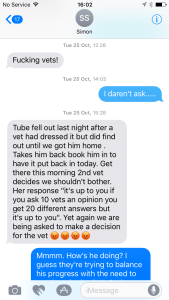
Please excuse the expletive, but that’s a real text from a friend. They’re well off, have no kids and their two whippets are their fur-children. For one of them, a bout of acute pancreatitis and a protracted period of anorexia in the aftermath led to the placement of a N-O tube. Their baby recovered and the well-equipped local vet hospital did a great job, but with two exceptions: Continuity of care and making a strong recommendation.

Continuity of care is a challenge in a big hospital and the topic of another blog, but the frustration expressed in the text message is about the type of decision making my friends where expected to participate in. Options galore, but no clear recommendation.

How do you make your therapeutic recommendations?

Dr Knows Best – paternalistic, priestly and telling only what you believe the client needs to know? It’s often denounced but still a common mode, especially for the vulnerable, frail and anyone who tends to do what they’re told.

Dr Informative – the vet is the tech expert and the client is the consumer? It’s a retail relationship where the vet provides the options and the consumer supplies the decisions. It can work beautifully is the choices are clear cut, trade offs straightforward and people have clear preferences. But it drives uncertainty, causes confusion and fuels fears. A really good vet put my friends in this place.

In truth, we want both information but crucially guidance, so a third way emerges:

Dr Interpretive – the vet’s role is to help determine what the client wants by asking, “What is most important to you? What are your worries?” Then, knowing your answers, they tell you about the options and what would most help you achieve your priorities.

Think hard about it and you’ll realize it’s easily encapsulated for most vets when the client asks, “What would you do if it were your pet?”

Emmanuel and Emmanuel[1] explore this in human medicine and note a fourth Deliberative mode too. Each style has the doctor adopt a conceptual role of guardian, technical expert, counselor or friend respectively. Where do you sit and where do you think you should be?

Consulting room theory, such as the Cambridge-Calgary model, always has making a recommendation as a key stage in the consultation. Have you checked the strength and clarity of your recommendations recently? Get in touch and we can help you make sure they stand out.

A pets’ life or a client’s satisfaction with your clinic could depend on it.


[1] Ezekiel J. Emanuel and Linda L. Emanuel.  “Four Models of the Physician-Patient Relationship.” JAMA 267:2221-6, 1992